
From Rags to Richness
How luxurious paintings were created from scarcity

The oldest oil paintings in the world adorn the walls of a few caves in Afghanistan. Dated to around 650 AD, the paintings reveal a mix of Chinese and Indian cultural influences and were probably created by artists who traveled the Silk Road. One of the most luxurious and expensive items traded along the famous route was the rich blue pigment used in the paintings themselves, a color just as deep and saturated now as it was over a thousand years ago.
Ultramarine. ‘Beyond the sea.’
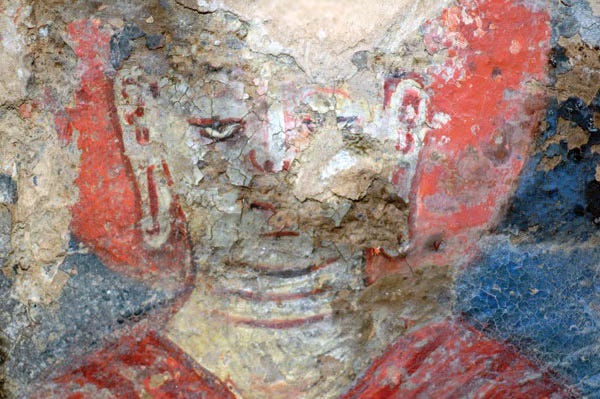
It wasn’t until the 12th century that European artists began to develop the oil painting techniques we are familiar with, but ultramarine has been found in art from the Tang Dynasty of China to Anglo-Saxon England. Several blue pigments were available in all these areas, but none were as rich and effective as ultramarine. And none were as expensive or as difficult to obtain.
The caves in Afghanistan are near what was the world's only lapis lazuli mine for over 6,000 years. Lapis lazuli is a metamorphic rock made of lazurite, pyrite, and calcite — and therein lies one of the reasons ultramarine is so expensive. Pyrite, you may know as ‘fool’s gold.’ Calcite is a creamy white carbonate mineral. Only the lazurite is blue. If you crushed a bunch of lapis lazuli, you’d have an unremarkable blue-grey powder.
Sometime before those first oil paintings were made, locals discovered how to mix the crushed rock with pine resin, wax, and oil, then dilute that into a lye solution. The lazurite sinks to the bottom, and the other minerals float to the top with the additives, which can then be skimmed. The process might have been repeated several times to get the deepest, richest blue powder that could be refined.
These labor-intensive techniques and the long, arduous export from Afghanistan made ultramarine more expensive than gold. Painters would have their pigment underwritten by nobles or the church, and it would only be used for the most significant parts of a painting, like the clothing of Jesus or Mary.
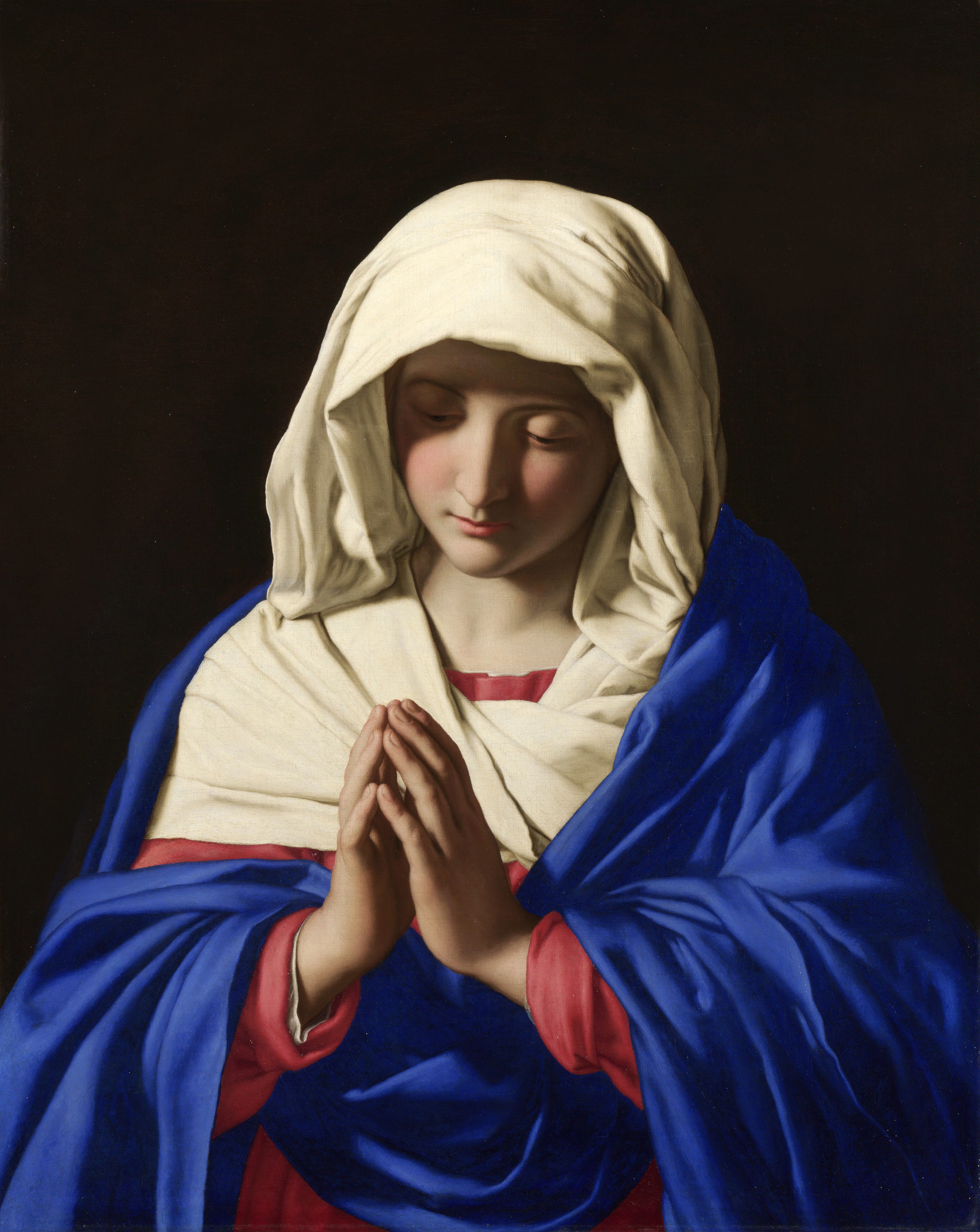
What artists quickly discovered is that ultramarine has a rare property among lightfast pigments. It is transparent. Painters would create essentially a black and white version of the item that would be blue in the finished work. They would let it dry completely. Then, they would blend the ultramarine powder thinly with oil, creating a glaze that they would spread very subtly in many layers, waiting for each one to dry before applying the next. The rich blue glaze inherited the carefully rendered folds of cloth, deep shadows, and brilliant highlights.
Light goes through the transparent glaze to the opaque layers beneath, bounces back through the glaze again, and creates a pearly, translucent, luxurious glow. Artists and patrons soon recognized that glazing was not just a way to economize with expensive pigments. It was a technique to achieve transcendent art.
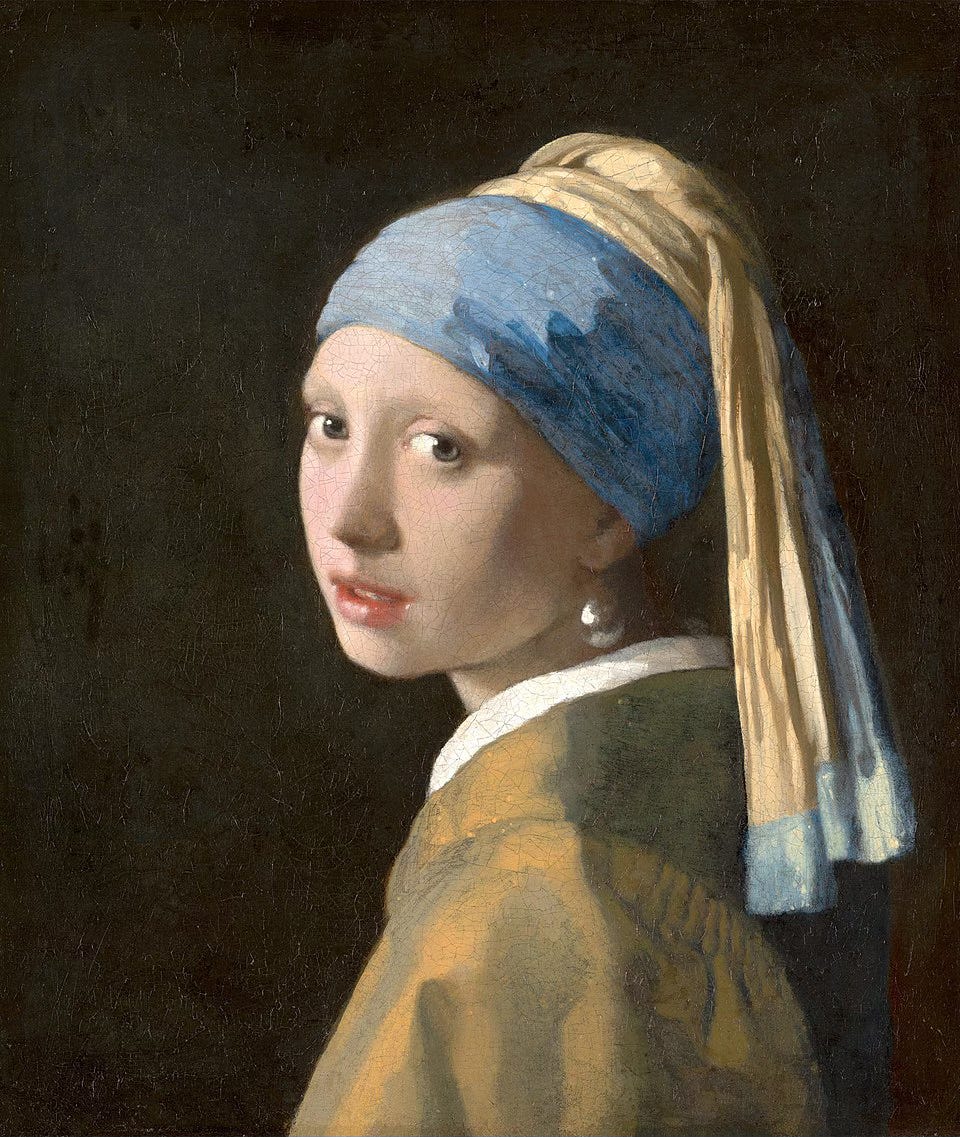
Painters began seeking out transparent pigments and creating transparent washes with glues and other mediums. The rhizomes of the madder plant produce a compound called alizarin, which the ancient Egyptians learned to chemically convert into a transparent, insoluble red pigment used more recently in the British ‘redcoat’ uniform. ‘Rose madder,’ ‘red lake,’ and ‘alizarin crimson’ were all produced by this process until alizarin was synthesized in 1868, putting an enormous number of farmers, laborers, and traders out of business overnight.
In 1824, a French society offered six thousand francs to anyone who could develop a synthetic alternative to ultramarine. The prize was awarded to Jean-Baptiste Guimet, and the artificial blue became known as “French ultramarine,” the same pigment I have on my palette.
French ultramarine is more saturated than natural ultramarine because it has none of the other mineral impurities that would be present to some degree in the original pigment. However, its blue is produced by the same chemical structure that exists in lapis lazuli, which strongly absorbs yellow-orange wavelengths of light, resulting in a rich blue that leans toward purple due to the inclusion of some red wavelengths. It is transparent, and it’s significantly cheaper than ultramarine.
Thanks to chemistry, many inexpensive transparent pigments are available today, like dioxazine purple, phthalo blue, and the quinacridones developed by DuPont in the 1950s. Ever since I started painting, I’ve wondered about this mysterious art of glazing, and I recently had a chance to try it.
What is scary about glazing is that you have a pretty good piece of art to begin with, and it feels like you’re about to roll the dice on it. Each layer can only make it darker, so you have to paint lighter and hope you’ve made it light enough. This is only my eighth painting, and I don’t have a lot of confidence to begin with.
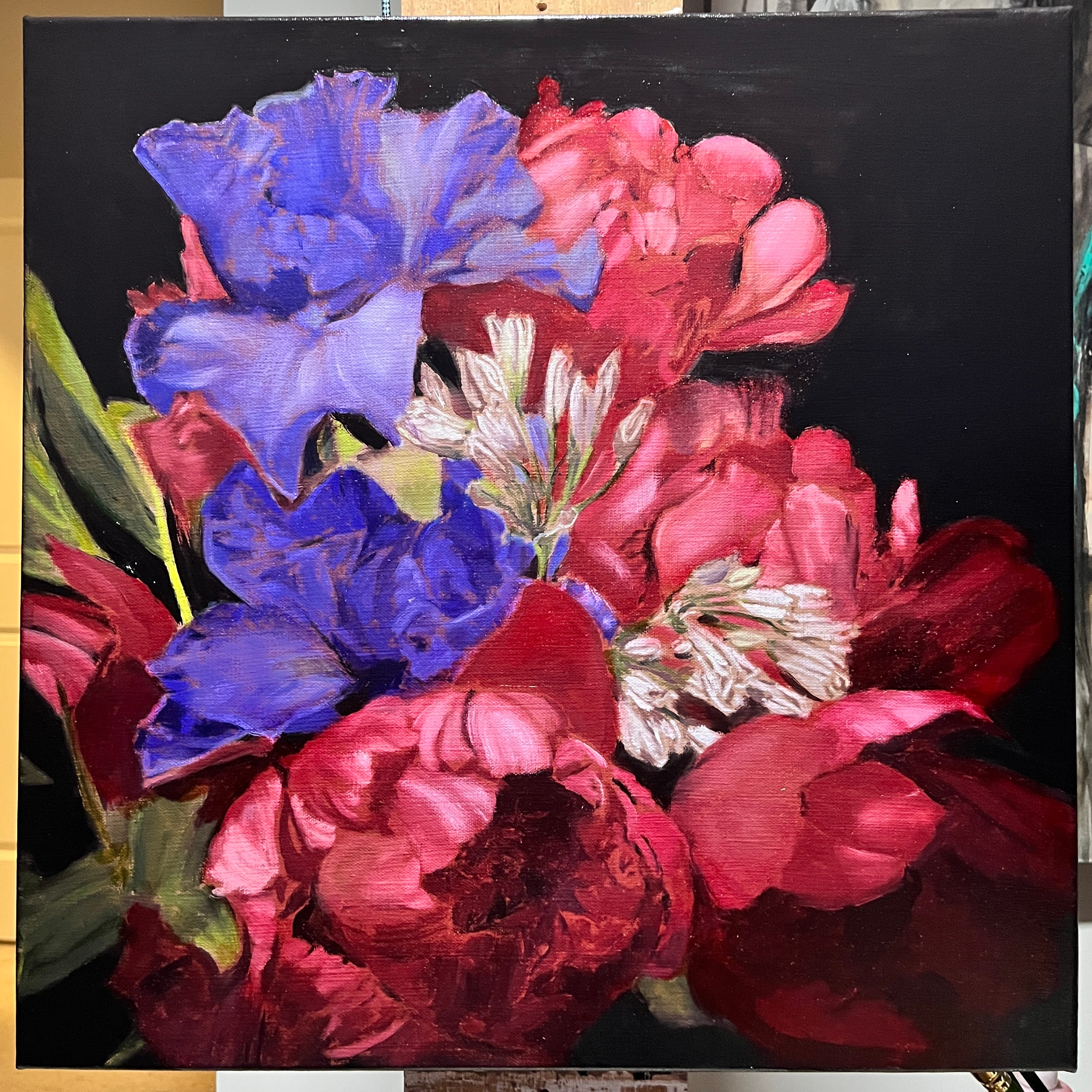
I did love the subject matter. I found a photo of flowers from my mother’s old house— Iris, old single peonies that smelled incredible, and the wild garlic weeds that looked better in a bouquet than they did in a flower bed.
(I toned a canvas about the color of a paper bag. It’s a nice, warm, neutral color to paint on.)


I let this dry for about two weeks in the garage, where it has been quite warm lately. Then I put it back on the easel and mixed my first glaze, French ultramarine with a dab of dioxazine purple for the iris. I made another glaze with alizarin crimson and glazed the peonies. The glazes were strong, and I ended up wiping off quite a bit. I went back with a titanium/zinc white while the glazes were wet and touched up the highlights. The white paint, although opaque, picked up a bit of the glazes and blended well with the colors. Lastly, I went around and reinforced the black background where the brown canvas was still peeking through.
What I love most about the process is that it began as a way to use as little of a precious resource as possible. So much about traditional oil painting is luxurious. It was funded by powerful people and institutions. Painters had apprentices who stretched linen and ground the sometimes-toxic pigments laboriously into drying oils. The works were designed to last for centuries.
Yet, the sumptuous richness of color, the translucent, opulent glow of the paintings that made them seem otherworldly, was an economy. The greatest painters of the Renaissance would have murdered fifty men for the pigments I have access to now. They would gasp at the way I wipe my palette with a paper towel and throw it away.
It’s a reminder to me to be grateful for the richness of my world. Every light switch. Every fitted sheet. Every soda water.
I was a performing songwriter for twenty-five years. Now I’m a physics undergrad. I’ve done a lot with very little for a long time. Whenever I drive by the Goodwill, I stop in and see if anyone has dropped off a bad painting or a kitschy photo printed on canvas. Three, four, maybe five bucks for fifty-dollar canvases. I strip any varnish and paint on them. I check the bargain bins at hobby stores for cracked tubes of paint. I never buy the cheap stuff, but I buy the good stuff cheaply.
And imagine this bouquet without the wild garlic.
So I guess I’m doing the same thing. I use what I can afford and turn it into beautiful things.
Didn’t cost nothin to type this.
Your fan,
Jonathan Byrd
This from OSU here in Corvallis, OR.
https://www.corvallisadvocate.com/2025/osu-research-a-rare-mineral-means-vibrant-new-pigments/
Wow, that is so cool to see the process. It's like you turned the lights on or brought the flowers out into the sun in that last one. Kudos!!