
Space Is Big. Time Is Short.
Good planets are hard to find.

Jason Pargin is a modern philosopher—not an academic, but someone who challenges his own perceptions, thinks deeply, and writes about it. He recently wrote a piece called Interstellar Space Travel Will Never, Ever Happen.
One long comment starts with, “Let’s talk about the physics…” and puts forward this argument for working on interstellar travel.
“As to the question of why we’d go, it depends on the time frame. The sun will not last forever. Once it starts transitioning to a Red Giant, survival on Earth will eventually become impossible as a matter of physics, not as a matter of technology.”
This is factual, and you might have read or heard this before. I’d like to point out a hidden assumption.
3 years ago, I looked almost the same as I do today.
30 years ago, I had blond curls, worked at a health food store, and played in a rock band.
300 years ago, people were building steam engines.
Doesn’t that feel like things escalated very quickly? Let’s try another.
3 million years ago, there were saber-toothed cats and mammoths.
30 million years ago, there were bears and deer.
300 million years ago was before dinosaurs.
Suddenly, from a planet we would recognize to one we would not. Two more powers of ten:
3 billion years ago, Earth was a big rock in space. If you landed a rover here, you would not have found life.
30 billion years ago, the Universe didn’t exist.
The expanding Sun might make the Earth unlivable in 300 million years.
We’re not going to be here ‘the dinosaurs didn’t exist’ from now. ‘The first big mammals’ from now. ‘Saber-toothed cats’ from now. Chicago was below a mile of ice for a hundred thousand years. How many of us would survive that winter?
Let’s try a different thing.
3 miles to the grocery store.
30 miles to Raleigh.
300 miles to Baltimore.
3,000 miles to Portland, Oregon.
I’ve driven to the grocery store. I’ve driven to Portland. In only three leaps in time, we were in a world of steam engines. This feels different. Let’s keep going.
30,000 miles is all the way around the Earth.
300,000 miles away is just past the Moon.
3 million miles away, a NASA spacecraft called OSIRIS-REx took this picture. That’s us, and our Moon.
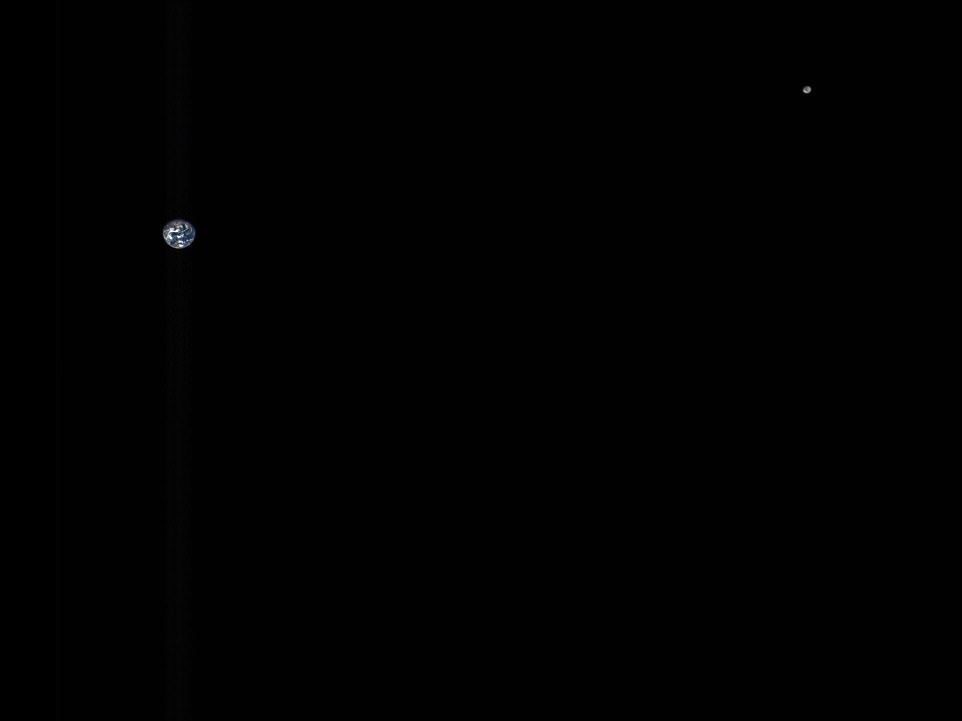
I mean, Earth is right there. Surely, there’s a surprising leap just about to happen:
30 million miles is around Mars’ orbit.
300 million miles is around Jupiter’s orbit.
3 billion miles is around Pluto’s orbit. Earth is a bright pixel in the rightmost band of light of this picture, the ‘Pale Blue Dot,’ taken from there.
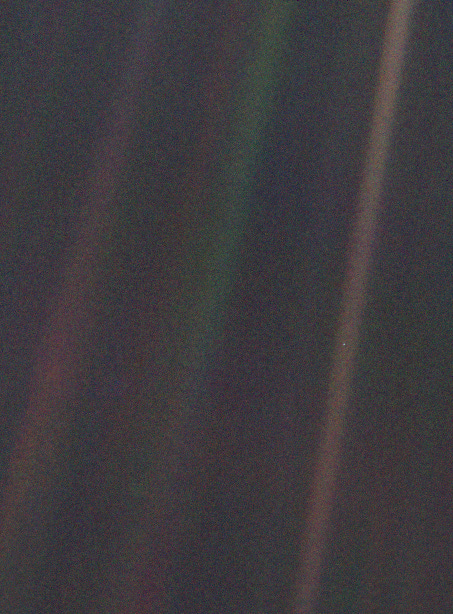
30 billion miles is near nothing (the Voyagers have gone about half this far).
300 billion miles is near nothing.
3 trillion miles is near nothing.
In time, after ten powers of ten, we were back before the Universe existed. In miles, we’ve gone twelve powers of ten, and we’re about half a light year away. The Parker Solar Probe, the fastest thing we’ve ever made, maxed out at 430,000 miles per hour. How long do you think it would have taken Parker to get there?
800 years.
Proxima Centauri is the closest star to us, about four light-years away. If you wanted to arrive there now, you would need to have boarded the fastest spacecraft we’ve ever made when humans invented the wheel. Hope you paid for that extra leg room.
Space programs are incredible investments. You might be using a satellite to read this essay. NASA developed the material in the glasses you’re wearing. All the benefits to humanity are hard to list. But we’re never going to travel to another star, and we’re not going to be around to see this one blow up.
With a little luck and good maintenance, a VW Bug will go a million miles. Barring any global catastrophes, a mammal species can last a million years. It’s a very good, very long life on a beautiful planet.
Space is big. Time is short. Enjoy the ride. Your fan,
Jonathan Byrd
Yes, but there are a few white men I would love to launch into outer space right now...🙄
Consciousness may be able to go the distance, we just won't have the type of body we have here.